Instructor Resources for Information and Communication Technology (ICT)
Professional teaching, laboratory and assessment support for educators using the Diploma in Information and Communication Technology (ICT) textbook series.
The dedicated Instructor's Guide supports lesson planning, technical instruction, practical laboratories, assessment, marking, remediation, moderation and continuous course improvement.
Supporting effective ICT teaching from planning to assessment.
A dedicated Instructor's Guide accompanies the Diploma in ICT textbook series.
The guide has been developed to help instructors plan lessons, teach technical concepts, conduct laboratories and assess learners consistently.
It complements the Foundation-to-Advanced 20-chapter textbook and provides practical support for structured institutional and classroom delivery.
Teaching + Labs + Assessment + Improvement
The Instructor's Guide connects classroom preparation, technical delivery, hands-on learning and assessment within one coordinated teaching framework.
Comprehensive support for teaching and assessment.
The guide provides resources for planning lessons, conducting practical learning, evaluating learner performance and maintaining consistent teaching and assessment standards.
Chapter-by-Chapter Teaching Guidance
Structured guidance to help instructors identify teaching priorities, key concepts and appropriate approaches throughout the 20-chapter curriculum.
Suggested Lesson Structures
Practical lesson structures that support preparation, explanation, demonstration, learner participation, practice and review.
Technical Solution Guidance
Detailed guidance supporting instructors when reviewing technical exercises, structured questions and practical activities.
Assessment Marking Schemes
Guidance for marking written and practical assessments consistently and fairly.
MCQ & Written-Assessment Guidance
Support for evaluating multiple-choice, short-answer, structured, analytical and written assessment activities.
Laboratory & Practical Guidance
Guidance for preparing, supervising and evaluating hands-on ICT laboratory and practical activities.
Expected Practical Evidence
Clear guidance on the evidence learners should produce when demonstrating practical competence.
Troubleshooting Guidance
Support for diagnosing common technical problems and helping learners develop systematic troubleshooting skills.
Technical Marking Rubrics
Standardized technical rubrics designed to improve consistency when assessing practical ICT work.
Remediation Strategies
Approaches instructors can use when learners need additional explanation, practice or support.
Extension Activities
Additional learning opportunities for learners ready to explore topics beyond the core activity requirements.
Assessment Moderation
Guidance supporting consistent assessment standards, review processes and quality assurance.
Capstone Assessment Framework
A framework for bringing together knowledge and practical skills through integrated end-stage assessment.
Responsible Generative AI Use
Guidance for responsible and academically appropriate use of generative AI in teaching and assessment.
Safety, Cybersecurity & Ethics
Guidance supporting laboratory safety, responsible technology use, cybersecurity awareness and professional ethics.
Instructor Reflection & Course Review
Tools to help educators reflect on delivery, learner outcomes and opportunities for continuous course improvement.
A practical teaching and assessment cycle.
The textbook and Instructor's Guide work together to support the major stages of effective ICT teaching.
Plan
Use chapter objectives, teaching guidance and suggested lesson structures to prepare instruction.
Teach
Explain concepts using the textbook, worked examples, demonstrations, illustrations and real-world applications.
Practise
Guide learners through laboratory activities, practical exercises, projects and troubleshooting tasks.
Assess
Evaluate learning using MCQs, written questions, practical evidence, marking schemes and technical rubrics.
Improve
Use remediation, extension, reflection and course-review guidance to strengthen learner outcomes.
Diploma in Information and Communication Technology (ICT)
Theory, Practice and Applications for Global Learners
The Instructor's Guide has been designed to accompany the comprehensive 20-chapter textbook and its seven-volume print series.
Chapters 1–10 establish essential ICT foundations, while Chapters 11–20 progress into programming, advanced databases, enterprise networking, software engineering, cybersecurity, web and mobile development, cloud computing, artificial intelligence, project management and data science.
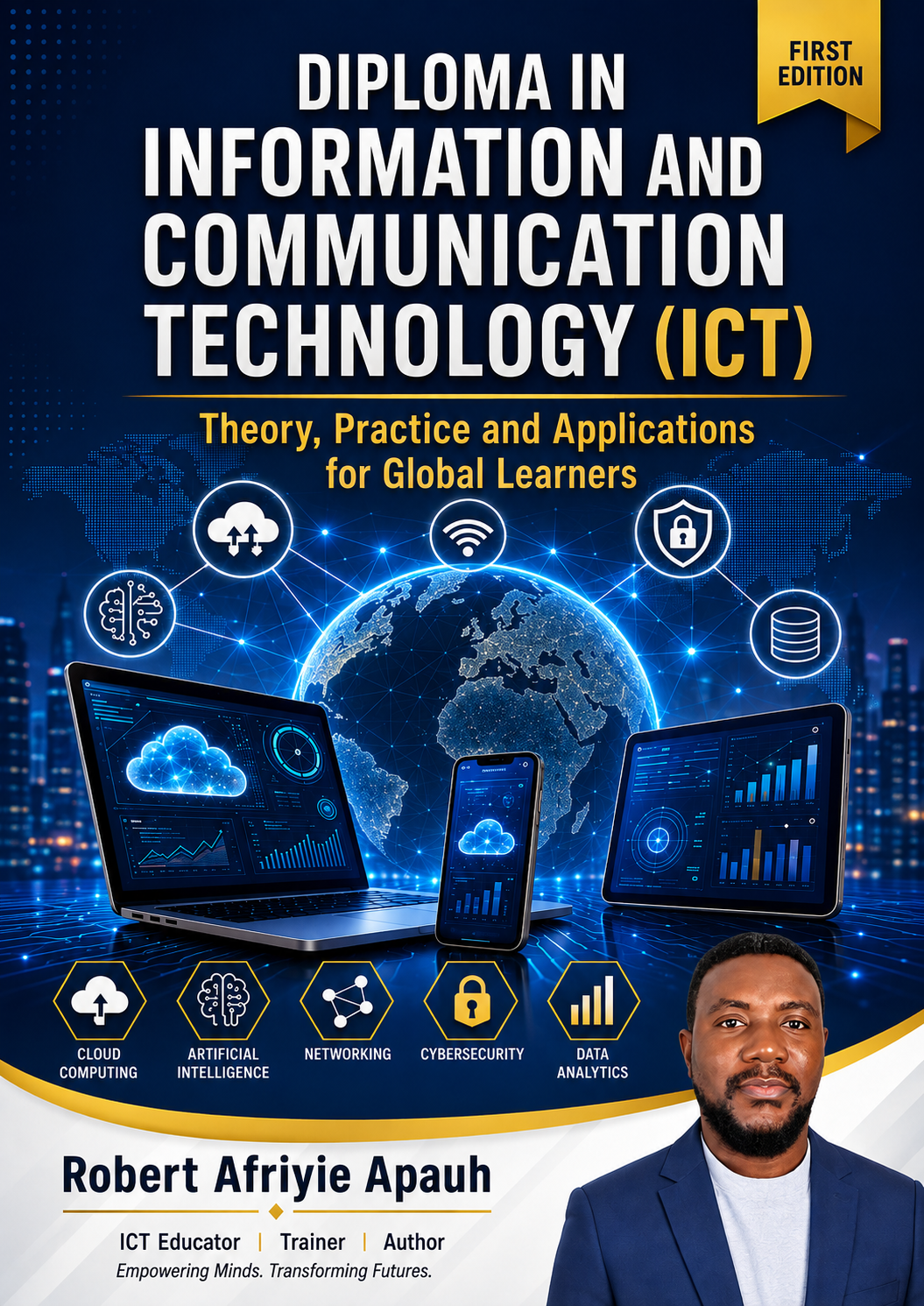
Connecting explanation with practical competence.
Teach the Concepts
Use chapter objectives, explanations, illustrations, worked examples and real-world applications to build understanding.
Demonstrate the Skills
Reinforce technical concepts through demonstrations, laboratory guidance and structured practical activities.
Assess Competence
Evaluate knowledge and skills through written assessments, practical evidence, projects and technical marking rubrics.
Support Progress
Apply remediation, extension activities and reflection tools to support different learner needs and improve outcomes.
Responsible use of generative AI in assessment.
Modern ICT education increasingly requires clear expectations for the appropriate use of artificial intelligence.
The Instructor's Guide includes guidance for responsible use of generative AI in assessment, helping educators maintain academic integrity while preparing learners to use contemporary digital tools responsibly.
Safety, cybersecurity and ethics.
Instructor guidance also addresses laboratory safety, cybersecurity awareness and ethical technology use so that practical learning develops both technical competence and professional responsibility.
Built for educators and learning organisations.
ICT Instructors
Educators delivering ICT courses, practical instruction and laboratory-based learning.
Lecturers & Trainers
Academic lecturers and professional trainers seeking a structured teaching and assessment resource.
Schools & Institutions
Schools, colleges, universities and training centres implementing structured ICT programmes.
Curriculum & Assessment Teams
Academic teams responsible for curriculum review, assessment quality, moderation and learning standards.
Evaluating the series for your programme or institution.
Instructor Review Copies
Lecturers, instructors and curriculum reviewers can enquire about review-copy availability for academic evaluation and possible institutional adoption.
Institutional Adoption
Educational institutions can discuss adoption of the textbook series for ICT programmes, courses and structured training.
Educational Partnerships
Institutions can contact Nadom I.T Solutions regarding educational partnerships, teaching resources and related publishing enquiries.
Tell us how you plan to use the ICT series.
Contact Nadom I.T Solutions about instructor resources, review copies, teaching support, institutional adoption or educational partnerships.
What to include with your enquiry.
Supporting practical, consistent and effective ICT teaching.
Explore the complete textbook series, request instructor resources or discuss institutional adoption and educational partnerships with Nadom I.T Solutions.