Diploma in Information and Communication Technology (ICT)
Theory, Practice and Applications for Global Learners
A comprehensive Foundation-to-Advanced ICT learning resource connecting academic theory, practical technology skills, laboratory learning, real-world applications and professional technologies across 20 chapters.
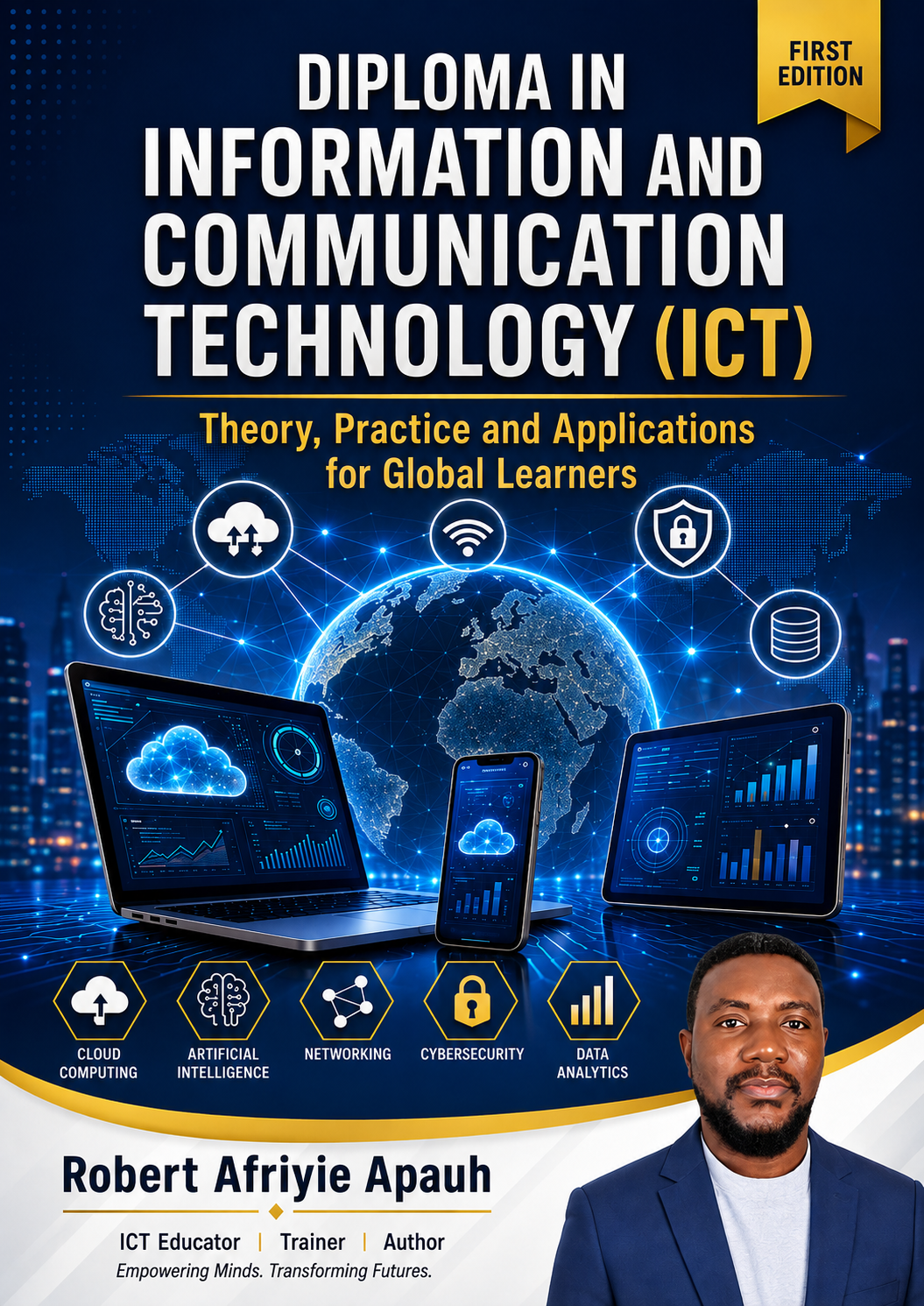
Diploma in Information and Communication Technology (ICT)
Theory, Practice and Applications for Global Learners
By Robert Afriyie Apauh, BSc (ICT), CCNA
Published by Nadom I.T Solutions
The textbook is designed to take learners from fundamental digital concepts to advanced professional and industry-oriented technologies.
Chapters 1–10 establish essential ICT knowledge and practical foundations, while Chapters 11–20 advance into programming, enterprise networking, advanced databases, software engineering, cybersecurity, cloud computing, artificial intelligence, project management and data science.
A complete ICT learning pathway.
20 Chapters
A structured learning progression from essential ICT foundations to professional and advanced technologies.
7 Print Volumes
The complete curriculum is organised into seven coordinated volumes for focused study, teaching and print publication.
Practical Learning
Laboratory exercises, worked examples, case studies, troubleshooting activities and practical projects reinforce applied competence.
Teaching Support
A dedicated Instructor's Guide supports lesson planning, laboratory teaching, assessment, marking and course review.
From ICT foundations to professional technologies.
One structured learning resource for classroom teaching, practical training and independent study.
Diploma in Information and Communication Technology (ICT): Theory, Practice and Applications for Global Learners is designed to take learners from fundamental digital concepts to advanced professional and industry-oriented technologies.
The text combines theory with practical application and is suitable for Diploma, TVET, university, professional training and independent learners.
Each chapter supports classroom teaching and self-directed learning through objectives, explanations, illustrations, worked examples, applications, case studies, practical activities, laboratory exercises, summaries, review questions and assessments.
Designed for understanding, practice and assessment.
Chapters 1–10
The Foundation Stage establishes the essential concepts, technologies and practical knowledge required for further ICT study.
Introduction to Information and Communication Technology (ICT)
Introduces ICT concepts, components, data and information, the historical development of ICT, applications of ICT, ethical and environmental considerations, emerging technologies and ICT careers.
Computer Systems and Hardware
Explores computer architecture and classification, processors, motherboards, memory, storage, input and output devices, ports and interfaces, maintenance, upgrades and hardware troubleshooting.
Computer Software and Operating Systems
Covers system and application software, operating-system functions, utility programs, programming-language translators, software licensing, installation, updating, maintenance and modern software trends.
Data Representation and Number Systems
Explains binary, decimal, octal and hexadecimal number systems, number conversions, binary arithmetic, storage units, character encoding, Boolean algebra, logic gates and digital representation.
Fundamentals of Computer Networks and Data Communication
Introduces data communication, network types and topologies, transmission media, networking devices, protocols and standards, OSI and TCP/IP models, IP addressing, subnetting, switching, routing, wireless networking, security and troubleshooting.
Internet Technologies, Web Development, and Cloud Computing
Explores Internet architecture and infrastructure, ISPs, the World Wide Web, browsers, search technologies, DNS, hosting, HTML, CSS, JavaScript, cloud service models, cloud deployment models, benefits, risks and future Internet technologies.
Fundamentals of Database Systems and Database Management
Introduces database concepts, DBMSs, database models, relational databases, keys and relationships, database architecture, users, database development, administration, security, ethics and emerging database technologies.
Systems Analysis and Design
Covers systems thinking, information systems, the systems analyst, SDLC, problem definition, feasibility analysis, requirements gathering, process and data modelling, object-oriented analysis, development methodologies, UI/UX design, implementation, testing and security.
Fundamentals of Cybersecurity and Information Security
Introduces the CIA triad, cyber threats, attacks, vulnerabilities, risk management, cryptography, network and endpoint security, application and cloud security, identity and access management, monitoring, incident response, business continuity and disaster recovery.
Emerging Technologies and the Future of ICT
Examines artificial intelligence, machine learning, generative AI, large language models, IoT, blockchain, robotics, virtual and augmented reality, 5G/6G, quantum computing, big data, green computing, ethical implications and future ICT careers.
Chapters 11–20
The Professional and Advanced Stage develops specialist, industry-oriented knowledge across software development, databases, networking, cybersecurity, cloud technologies, artificial intelligence, project management and data science.
Programming and Software Development
Introduces problem solving, algorithms, programming languages and paradigms, variables and data types, operators, input/output, selection, loops, functions, collections, object-oriented programming, files, debugging, testing and software development practices.
Advanced Database Systems and Administration
Develops advanced database knowledge through relational design, ER modelling, keys and integrity constraints, normalization, SQL, transactions, concurrency, database security, backup and recovery, performance management and database administration.
Advanced Computer Networks and Enterprise Networking
Develops professional networking skills through enterprise network design, switching, routing, VLANs, IP services, WAN technologies, wireless networking, network security, virtualization, software-defined networking, monitoring, troubleshooting and resilience.
Software Engineering
Explores professional software development through requirements engineering, modelling, software architecture, development methodologies, design, implementation, testing, quality assurance, version control, maintenance, project management and professional software-engineering practice.
Advanced Cybersecurity and Enterprise Information Security
Extends cybersecurity into enterprise environments through threat analysis, governance, risk management, security architecture, IAM, network and endpoint defence, application and cloud security, SOC operations, incident response, digital forensics, business continuity, compliance and ethical security testing.
Web and Mobile Application Development
Covers modern web and mobile application architecture, front-end and back-end development, APIs, responsive design, mobile development, data integration, testing, application security, deployment and maintenance.
Cloud Computing and Virtualization
Examines cloud architecture, service and deployment models, virtualization, containers, cloud storage and networking, identity and security, availability, scalability, monitoring, cost management, migration and cloud governance.
Artificial Intelligence and Machine Learning
Introduces AI and machine-learning foundations, data preparation, supervised and unsupervised learning, model evaluation, neural networks, generative AI, responsible AI, practical applications and AI deployment.
IT Project Management
Covers the ICT project life cycle, project scope, scheduling, cost management, stakeholders, communication, risk, quality, resources, procurement, Agile and predictive approaches, project monitoring, control and closure.
Data Science and Big Data Analytics
Introduces the data-science lifecycle, data collection and preparation, exploratory analysis, statistics, visualization, big-data concepts and technologies, analytics, governance, privacy, ethics and communication of data-driven findings.
Learning that moves beyond theory.
The series is designed to develop both conceptual understanding and practical ICT competence.
Learners encounter hands-on exercises, demonstrations, real-world scenarios, case studies, assessments, projects and troubleshooting activities throughout the chapters.
This combination helps learners understand ICT concepts, practise technical skills, solve problems and apply knowledge in realistic academic and professional contexts.
Practice + Assessment + Application
One complete curriculum. Seven coordinated volumes.
For easier teaching, learning and print publication, the complete textbook is organised as a coordinated seven-volume series.
ICT Foundations
Chapters 1–4
Core ICT concepts, computer systems, hardware, software, operating systems, data representation and number systems.
Networking, Internet and Cloud Foundations
Chapters 5–6
Computer networking, data communication, Internet technologies, web development and cloud-computing foundations.
Database Systems and Management
Chapter 7
Database concepts, DBMS technologies, relational databases, administration, security and emerging database technologies.
Systems Analysis and Design
Chapter 8
Systems thinking, SDLC, requirements analysis, modelling, development methodologies, interface design, implementation and testing.
Cybersecurity, Emerging Technologies and Programming
Chapters 9–11
Cybersecurity foundations, emerging technologies, future ICT developments, programming and software-development fundamentals.
Advanced Databases and Enterprise Networking
Chapters 12–13
Advanced database administration and professional enterprise networking technologies.
Professional and Advanced ICT Technologies
Chapters 14–20
Software engineering, advanced cybersecurity, web and mobile development, cloud computing, AI, project management and data science.
Together, the seven volumes provide a progressive learning pathway from introductory ICT concepts to advanced professional technologies.
Choose the format that suits your learning.
Complete twenty-chapter digital edition.
The complete twenty-chapter textbook is available as a Kindle eBook for convenient study on compatible electronic devices.
Seven-volume print series.
The complete curriculum is organised into seven coordinated print volumes for portability, focused study, teaching and classroom use.
Professional teaching and assessment support.
A dedicated Instructor's Guide accompanies the textbook series and has been developed to help instructors plan lessons, teach technical concepts, conduct laboratories and assess learners consistently.
This makes the series suitable not only for individual learners but also for structured institutional and classroom delivery.
Resources for planning, teaching and assessment.
Designed for learners, educators and institutions.
Diploma & TVET Students
Learners developing a strong academic and practical foundation across the major areas of ICT.
University Students
Students requiring a comprehensive ICT reference covering foundational, professional and emerging technologies.
ICT Instructors & Institutions
Educators and training organisations seeking a structured classroom resource supported by practical activities and an Instructor's Guide.
Professional & Independent Learners
Certification candidates, career changers and lifelong learners strengthening their ICT knowledge and practical competence.

Robert Afriyie Apauh, BSc (ICT), CCNA
ICT educator, researcher, trainer and network specialist based in Ghana.
Robert Afriyie Apauh holds a Bachelor of Science in Information and Communication Technology from Presbyterian University, Ghana, and is a Cisco Certified Network Associate (CCNA), with additional training and certification in cybersecurity and IT support.
His professional and educational experience spans computer networking, hardware and software troubleshooting, systems administration, digital technologies and ICT training.
Diploma in Information and Communication Technology (ICT): Theory, Practice and Applications for Global Learners reflects his commitment to connecting academic theory, practical skills and contemporary industry technologies.
Technology. Education. Innovation.
Supporting accessible technology education and professional development.
The Diploma in ICT series forms part of Nadom I.T Solutions' commitment to technology education, professional development and accessible ICT learning resources for learners around the world.
Build the ICT knowledge and practical skills today's digital world demands.
Contact Nadom I.T Solutions for book availability, digital or print edition enquiries, institutional requests, instructor resources or educational partnerships.